Ticks in Wisconsin
The best local tick pest control company in Wisconsin. Guaranteed.
TICK SPECIES IN WISCONSIN
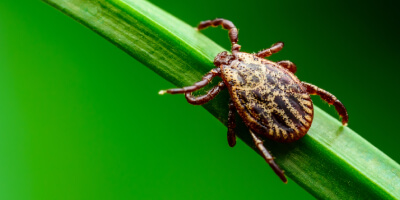
The most prominent cockroaches in Wisconsin are the German cockroach, the Oriental cockroach, and the American cockroach. Anyone The most prominent species of ticks in Wisconsin are the American dog tick, the black-legged tick, and the lonestar tick. While you don’t want any of these ticks in your yard or on your family, black-legged ticks, more commonly known as deer ticks, are the only known vector for Lyme disease. That makes ticks not just annoying – but dangerous. Fortunately, OPC Pest Services can handle them for you.
But you should know what to look for when it comes to deer ticks. When unengorged (i.e. not filled with blood), the female blacklegged tick is roughly 1/8”, while male ticks are slightly smaller at about 1/16”. Both male and female deer ticks have flat, oval bodies, and are not hard-shelled. Female deer ticks are orangish brown in color except for their legs, mouthparts, and scutum (shield). Unengorged, their abdomen is a dark reddish-brown color but becomes darker after feeding on a host. Male deer ticks are reddish brown overall.
The blacklegged tick is longer than wide, and its sharply pointed toothed mouthparts are clearly visible from above. Newly hatched unengorged larvae are about 1/32” long and have 6 legs. Unengorged nymphs (baby ticks) are about 1/16” long and have 8 legs.
They prefer vegetation located in transitional areas such as where forest meets field, mowed lawn meets unmowed fence line, or a foot trail through high grass or forest as these areas are where most animals travel sometime during each 24-hour period.
The other habitat most likely to harbor blacklegged ticks is the den, nest, or nesting area of its host such as that of skunks, raccoons, opossums, but especially the white-footed mouse. The white-footed mouse prefers woody or brushy areas. It nests in any place that gives shelter such as below ground, in stumps, logs, old bird or squirrel nests, woodpiles, buildings, etc. These mice can bring ticks in with them if they enter your home.
But you should know what to look for when it comes to deer ticks. When unengorged (i.e. not filled with blood), the female blacklegged tick is roughly 1/8”, while male ticks are slightly smaller at about 1/16”. Both male and female deer ticks have flat, oval bodies, and are not hard-shelled. Female deer ticks are orangish brown in color except for their legs, mouthparts, and scutum (shield). Unengorged, their abdomen is a dark reddish-brown color but becomes darker after feeding on a host. Male deer ticks are reddish brown overall.
The blacklegged tick is longer than wide, and its sharply pointed toothed mouthparts are clearly visible from above. Newly hatched unengorged larvae are about 1/32” long and have 6 legs. Unengorged nymphs (baby ticks) are about 1/16” long and have 8 legs.
They prefer vegetation located in transitional areas such as where forest meets field, mowed lawn meets unmowed fence line, or a foot trail through high grass or forest as these areas are where most animals travel sometime during each 24-hour period.
The other habitat most likely to harbor blacklegged ticks is the den, nest, or nesting area of its host such as that of skunks, raccoons, opossums, but especially the white-footed mouse. The white-footed mouse prefers woody or brushy areas. It nests in any place that gives shelter such as below ground, in stumps, logs, old bird or squirrel nests, woodpiles, buildings, etc. These mice can bring ticks in with them if they enter your home.
What Problems Do Ticks Cause in Wisconsin
Black-legged ticks, more commonly known as deer ticks, are the only known vector for Lyme disease. That is the main problem that particular tick causes and we just happen to have them in our area. Lyme can be serious and will only get worse without treatment. It’s not something you want to play around with. Unfortunately, it’s also not the only disease this tick can transmit. This tick is of medical importance because in addition to its ability to transmit, in addition to Lyme disease, anaplasmosis, human babesiosis, Powassan encephalitis, and more. And it’s not just people this tick will bite. They will bite any warm-blooded animal – including our pets. So, tick treatments are about more than taking care of a nuisance. They are about the safety and health of all of us.
Satisfaction Guarantee
Fast Response Times
Board Certified Entomologists
Tick Control Services in Wisconsin
Getting rid of ticks in Wisconsin is a job for pest control experts who are most familiar with the specific tick species activity in and around the Badger State. The local expertise, knowledge, and experience provided by the professionals at OPC Pest Services include almost 70 years of controlling and treating for ticks and many other pests in Southern Wisconsin. We can help you quickly root out the problems you’re having in the outdoor areas around your Wisconsin home or business.
Need help with ticks?
Get My Quote

