Ground Beetle Facts & Information
Everything you need to know about ground beetles
What Do Ground Beetles Look Like?
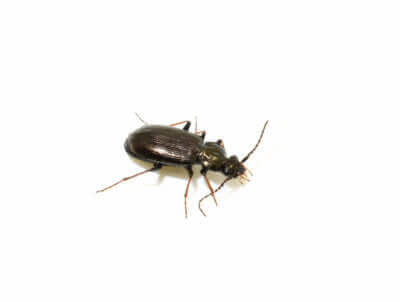
Ground beetles belong to the family Carabidae, which includes at least 34,000 species with a wide range of sizes, shapes, and colors. Most adult ground beetles are between about 1/8 and 1 1/2 inches long, although their appearance varies considerably by species. They are commonly black, brown, or metallic in color and typically have a flattened, elongated body with relatively long legs and prominent jaws.
Ground beetles are usually identified by their hard wing coverings, called elytra, which meet in a straight line down the center of the back. Many species have ridges, grooves, or other distinctive markings on their wing coverings. Their heads are generally visible from above, and they have well-developed mandibles used to capture and consume prey.
Ground beetles are predators and commonly feed on insects, insect larvae, caterpillars, slugs, snails, and other small organisms. Some species can consume their own body weight in food every day. Because of these feeding habits, many ground beetle species are actually beneficial outdoors and can help naturally reduce populations of other pests.
Ground beetles are primarily nocturnal and are often seen running quickly across the ground when disturbed. The Australian tiger beetle (Cicindela hudsoni) holds the record at 2.5 meters per second, or about 5.6 mph. Most species do not fly frequently, although many are capable of flight. During the day, they typically hide beneath rocks, logs, leaves, mulch, landscaping materials, or other protected areas.
Ground beetles are generally harmless to humans. If handled, they may decide to emit a strong-smelling odor. A broom or cup can relocate a lost beetle back outside if needed.
Ground beetles are usually identified by their hard wing coverings, called elytra, which meet in a straight line down the center of the back. Many species have ridges, grooves, or other distinctive markings on their wing coverings. Their heads are generally visible from above, and they have well-developed mandibles used to capture and consume prey.
Ground beetles are predators and commonly feed on insects, insect larvae, caterpillars, slugs, snails, and other small organisms. Some species can consume their own body weight in food every day. Because of these feeding habits, many ground beetle species are actually beneficial outdoors and can help naturally reduce populations of other pests.
Ground beetles are primarily nocturnal and are often seen running quickly across the ground when disturbed. The Australian tiger beetle (Cicindela hudsoni) holds the record at 2.5 meters per second, or about 5.6 mph. Most species do not fly frequently, although many are capable of flight. During the day, they typically hide beneath rocks, logs, leaves, mulch, landscaping materials, or other protected areas.
Ground beetles are generally harmless to humans. If handled, they may decide to emit a strong-smelling odor. A broom or cup can relocate a lost beetle back outside if needed.
How did I get ground beetles?
There are more than 800 species of ground beetles, making them the most frequently encountered beetles in yards and gardens. They usually live in the soil under logs, rocks, wood, leaves, boards, and other debris in agricultural areas like fruit orchards, happily eating garden pests and plants. They are very active at night. But they are attracted to light and in the summertime can congregate around well-lit homes and businesses, before entering all at once and creating an infestation. They gain access through cracks, crevices, and other small openings, and can be found hiding in damp basement areas or under objects on the floor.
Where Do Ground Beetles Live?
Ground beetles are found in a wide variety of outdoor environments, including gardens, lawns, fields, forests, agricultural areas, and landscaped properties. Many species prefer damp, protected locations where they can find both shelter and prey.
Around homes and commercial buildings, ground beetles may be found beneath mulch, stones, boards, logs, leaf litter, vegetation, and other debris. They can also gather around exterior lighting at night because their prey may be attracted to the lights.
Inside buildings, ground beetles are usually accidental invaders rather than established indoor pests. They may be found along floors, windows, walls, basements, garages, entryways, and other areas after making their way indoors.
Around homes and commercial buildings, ground beetles may be found beneath mulch, stones, boards, logs, leaf litter, vegetation, and other debris. They can also gather around exterior lighting at night because their prey may be attracted to the lights.
Inside buildings, ground beetles are usually accidental invaders rather than established indoor pests. They may be found along floors, windows, walls, basements, garages, entryways, and other areas after making their way indoors.
What Problems Do Ground Beetles Cause
Ground beetles are generally considered nuisance pests rather than destructive structural or stored-product pests. They do not typically damage buildings, furniture, clothing, or stored food. Their presence indoors can nevertheless be alarming, particularly when numerous beetles suddenly appear.
The primary problem associated with ground beetles indoors is their presence as an unwanted nuisance. They may crawl across floors, walls, windows, and other visible areas. Although they generally do not bite people, their large jaws can make them appear intimidating.
The primary problem associated with ground beetles indoors is their presence as an unwanted nuisance. They may crawl across floors, walls, windows, and other visible areas. Although they generally do not bite people, their large jaws can make them appear intimidating.
How Can I Prevent Ground Beetles?
Preventing ground beetles starts with reducing the conditions that attract and shelter them around the building. Keep mulch, leaf litter, grass, weeds, and other vegetation from accumulating directly against the foundation. Remove unnecessary boards, rocks, debris, and other potential hiding places near the structure.
Sealing cracks and gaps around foundations, doors, windows, vents, utility penetrations, and other potential entry points can also help prevent beetles from getting inside. Make sure doors close tightly and that door sweeps and screens are in good condition.
For commercial properties, regular inspections around the exterior of the building can help identify areas where ground beetles may be harboring. An integrated pest management (IPM) program can address exterior conditions, entry points, and pest pressures while minimizing unnecessary treatments.
If ground beetles are becoming a recurring problem, professional pest management can help identify where they are coming from and develop a targeted strategy to reduce their presence around the property.
Sealing cracks and gaps around foundations, doors, windows, vents, utility penetrations, and other potential entry points can also help prevent beetles from getting inside. Make sure doors close tightly and that door sweeps and screens are in good condition.
For commercial properties, regular inspections around the exterior of the building can help identify areas where ground beetles may be harboring. An integrated pest management (IPM) program can address exterior conditions, entry points, and pest pressures while minimizing unnecessary treatments.
If ground beetles are becoming a recurring problem, professional pest management can help identify where they are coming from and develop a targeted strategy to reduce their presence around the property.
Why OPC?
We’re passionate about keeping ground beetles out of your home or business because we live and work here – it’s our neighborhood, too. We’ve been keeping homes and businesses in Kentucky, Ohio, Illinois, Indiana, and Wisconsin safe from pests since 197
Expert pest control since 1972
Quality Pro certified company
Satisfaction guarantee

Need help with ground beetles?
GET MY QUOTE
